Marxism

Marxism is a theory/philosophy named after Karl Marx. It focuses on the social, political, and economic aspects of life. The Marxist theory first came into being when in 1848, Karl Marx and Fredrich Engels collaboratively published The Communist Manifesto, a pamphlet where they formulated the concept of class conflict and talked about an inevitable revolution. Later, in his book, Das Capital (published in 1867), Marx focused on criticizing Capitalism and discussed the effects of capitalism on labor. Let us now look at the fundamental premises of Marxism.
1. Marxism is concerned with the economic structures of human society.
2. Marxism believes that keeping economic power is the motive behind every activity in this world including education, politics religion, etc.
3. Economics is the 'base' on which the 'superstructure' of social, political, and ideological realities are built.
4. Economic power therefore always includes social and political power as well.
5. In Marxist terminology, economic conditions are referred to as material circumstances. And the social, political, and ideological atmosphere is generated by the material condition called the 'historical situation'.
6. Marxism believes in praxis. Ideas can be judged as valuable only if they can be applied in practical life.
7. For Marxism, the socio-economic differences are much more significant than the differences of race, ethnicity, religion, gender, etc.
Class Struggle/class conflict
Marx divided social classes into two broad categories based on their economic wealth.
1. Proletariat: These are the people who earn only a little money, and they do not have any means of production (factories and industry) of their own. They just work in the factories of the capitalists. Proletariat are reduced to selling their labor power just for a living.
According to Marxist theory, The capitalists try to keep the working class under their control because their profits depend on an efficient management of the working class. That's why these two classes are always in conflict. This conflict is called the social relations of production. In a feudal society, peasants are exploited by the landlords. similarly, factory workers are exploited by the owners of the factory. However, Marx believed that someday these proletariats will spontaneously revolt against their oppressors and create a classless society.
But it is really difficult to classify who is the proletariat and who is the bourgeoisie. Neither all of the working class are the proletariat, nor all the owners are the bourgeoisie. Some owners earn less than their employees. So, we can divide people into five classes in terms of how they live.
1. Underclass - Homeless.
2. Lower class- they have homes but they fear losing them.
3. Middle class- they have homes and cars, but they do not have mansions.
4. Upper class- they have homes, cars, and mansions. But they do not have all the luxuries.
5. Aristocrats- They have homes, cars, mansions, privet jets, and every luxury one can think of.
The underclass and lower class are totally oppressed by the economy. Middle-class people have financial
security and are more or less privileged, but they are often hit by recessions. The upper-class and the aristocrats are not affected by anything.
Now just think, if the first three sections of society are oppressed by the economy, why don't they fight back? General reason: no one has the time to be politically active. How can one be! Especially, when they are fighting every day just to stay alive! But there is also another reason. And that is ideology. We will get back to this topic later. But before that, we need to understand one more concept, i.e., base and superstructure.
Base & Superstructure
In Marxist theory, society consists of two parts:
the base (or substructure) and the superstructure. The base refers to the mode of
production which includes the forces and relations of production (e.g. employer-employee work conditions, the technical division of labour, and property relations) into which people
enter to produce the necessities and amenities of life.
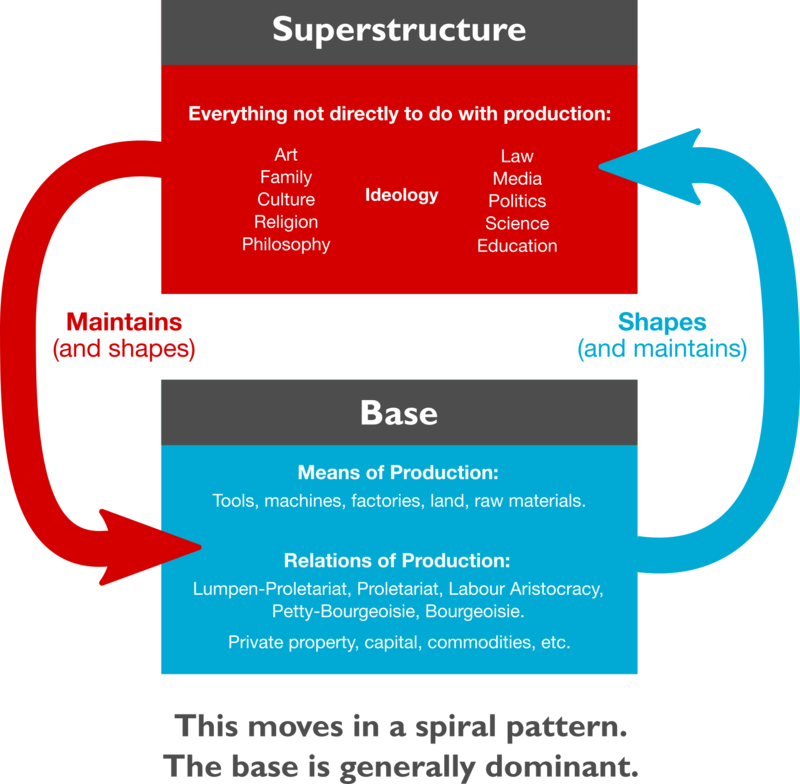
The superstructure refers to society's other relationships and ideas not directly relating to production including its culture, institutions, political power structures, roles, rituals, religion, media, and state. The relation between the two parts is not strictly unidirectional. The superstructure can affect the base. However, the influence of the base is predominant.
Ideology
An ideology (or False consciousness) is a belief system, and all belief systems are products of cultural conditioning. Capitalism, communism, patriotism, religion, humanism, astrology, and veganism, all are ideologies. Even our assumption that nature behaves according to the laws of physics is an ideology. But all ideologies are not the same. Some are productive and desirable, and some are repressive and generally have some political agendas.
Politically driven ideologies often assert the 'naturalness' and necessity of economic practices. Therefore, ideology is an instrument of power because it helps dominant classes by naturalizing the 'not-so-natural' or 'unnatural' and convincing the dominated class that this is how things are.
For instance, 'every individual should have their own property' is actually an ideology that promotes capitalism. In this world, many tribes believe that land can't be owned. For them, it's like trying to own the air we breathe.
Let us look at another example. The middle-class tends to resent the poor because so much middle-class money goes to the government programs to help the poor. However, middle-class people fail to understand two important socio-economic realities.
1. It is the wealthy in the position of power who decide who pays the most taxes and how the money will be spent. In other words, it is the upper-class people who make the middle class help the poor.
2. Poor people get only a little amount of that money; the rest always goes to the pockets of the wealthy.
Most successful ideologies are not easily recognizable as ideologies but are thought to be natural ways of seeing the world. Ideologies are sustained, reinforced, and reproduced through cultural forms such as art. American movies often depict America as the savior of the world. This is an ideology that masks the exploitative relationship America has with other nations such as third-world countries. Let us look at another example of how ideologies are reinforced through Cultural artifacts.
In a sitcom, representing a homeless man, it is shown that the man sleeps every night in a bus station, where the sitcom is set. We see him in a public phone booth, talking on a phone when he is interrupted by a postman who gives him a mail. (Laughter track is played. The guy hangs around the station so much that the post office thinks it's his home!) He inspects the mail and makes a casual comment: I wish the post office would do something about the junk mail! (Another big laughter)
This scene may seem innocent enough, but a Marxist critic would see in it an implied message that serves the capitalist power structure in the world: "don't worry about the homeless" or, even worse, "They are doing fine for themselves" or, "The homeless like to live this way; it's natural to them as our lifestyle is to us."
Therefore, from the above examples, we can see that ideology or false consciousness is a "mode of misrecognizing the true nature of our material lives and social roles when we consume a cultural artifact." Through Ideologies, we perceive the world.
Hegemony
Hegemony is a term popularized by the Italian thinker, Antonio Gramsci. It is like ideology, but it is more than that. Hegemony is the domination of one particular group or section of society by the powerful classes. Let us look at some of the characteristics of hegemony.
- domination is not necessarily achieved through threats of violence or coercion of law but by winning their consent to be dominated.
- Hegemony includes ideology/ false consciousness because hegemony works most effectively when the dominated group accepts to be dominated.
- Hegemony refers to the process, through which the dominant classes maintain power. Ideology is one of those processes.
- Hegemony tends to 'naturalize' and legitimize an unequal power relation often by suggesting that the condition is mutually beneficial.
- Hegemony is achieved through the circulation of ideology.
the idea of Interpellation is introduced by Luis Althusser to explain the process of accepting the ideology without being aware of it. According to him, ideology makes one believe that s/he is an independent being and not at all controlled by outside forces. In other words, ideology interpellates an individual as a subject but makes her/him believe s/he is a free agent. Thus, women choose pre-determined gender roles such as 'mother', 'daughter', 'wife', etcetera without being aware of it.
Bibliography:
1. Nayar, Pramod K. Contemporary Literary and Cultural Theory: From Structuralism to Ecocriticism. Uttar Pradesh, India: Pearson India Education Services Pvt, 2017. Print.
2. Tyson, Lois. Critical Theory Today. Third ed. Taylor and Francis, 2019. Print.
3. "Marxism - Wikipedia." https://en.wikipedia.org/wiki/Marxism?msclkid=ac2976c3b84811ec8bb2952c2a073ff0, Accessed 1 April. 2022.


The "improved" one. Carry on bro
ReplyDeleteThanks, bro!
Delete